

We live in unprecedented times, where we find ourselves more attached to a rectangular device than to other people, or even ourselves. The ever-growing landscape of social media, now boosted with such novel technologies like Open AI, has plunged us into a world that is gradually becoming unrecognizable. We were once sold on the idea of its benefits – that these social media platforms would help bridge the gap between us, help connect us to one another, make information flow seamlessly, and remove redundant tasks from our daily lives. But at what cost one might ask? These platforms are akin to the first years of a newlywed couple: everything seems perfect, what could go wrong? Yet here we are, as a global society, now witnessing first-hand the pervasive and addictive nature of these platforms. We see their true intentions, masks stripped off, and the allure of a honeymoon phase having faded. And now the so-called benefits we had been sold have turned out not to be benefits at all. Instead of closing the distance, many people, particularly young people, feel lonely and isolated from society. Instead of helping us connect to each other, we are inflamed by jealousy or hatred for others. Instead of making us more informed, we are rather stuck in echo-chambers or drowned in anti-intellectualism. In the end, what these platforms have done to us is exactly what was intended in the first place. Not to have a better informed and deeply connected society, but to have a reservoir of benumbed people whose minds have been primed to meander the networks of these platforms. And this comes not ‘as a means’ but an end. An end to what, exactly? Profit, meeting the margins, and even more profit. Most technologies begin their course of life with a speech of benevolence. But time quickly shows what the purpose of the technology had always been. And in due time, these profiteering technologies have managed to have us right where they wanted – subversively dependent on them, in other words addicted to their products. In his book titled, Irresistible: The Rise of Addictive Technology and the Business of Keeping us Hooked, Adam Atler writes,
‘Tech isn’t morally good or bad until its wielded by the corporations that fashion it for mass consumption. Apps and platforms can be designed to promote rich social connections; or, like cigarettes, they can be designed to addict. Today, unfortunately, many tech developments do promote addiction.’[1]
But what pockets of life remain in a future that is becoming overtly digitized. Well, there are many to be had, one just needs to have the courage to go cold-turkey, as the Americans say, and log out of the system. Some prescribe outdoor activities, others choose to have meditative retreats, and some even find religion as the best mitigator. All these paths are plausible and will serve each individual according to their need. But one other way of detoxing from social media, that is not so commonly spoken about, can come in the form of engaging with artistic media (physical or nondigital preferably) as a means to overcome or minimize the effects of social media addiction. For the rest of this essay I would like to present a discussion on why artistic media, when engaged with meaningfully, can help address the negative effect driven by these global social networking platforms. But first, a word on the stats.
Our Issue with the Internet
According to the Irish Times, ‘Overall, social media usage rose by two percentage points, with 75 per cent of people in Ireland surveyed having used platforms such as Facebook, Instagram and WhatsApp...’[2] StatCounter has shown that Facebook maintains its dominance on social platforms, reserving the highest user base and market share. WhatsApp leads the messaging app with a usage that runs over 72%. Instagram comes down at a mere 5.2%. Whereas TikTok has seen steady growth, in part due to the Covid-19 pandemic, with about 2.16 million adult users, particularly Gen Z. And the Platform X (formerly known as Twitter) has maintained a solid user base, who mostly rely on it for the news.[3]
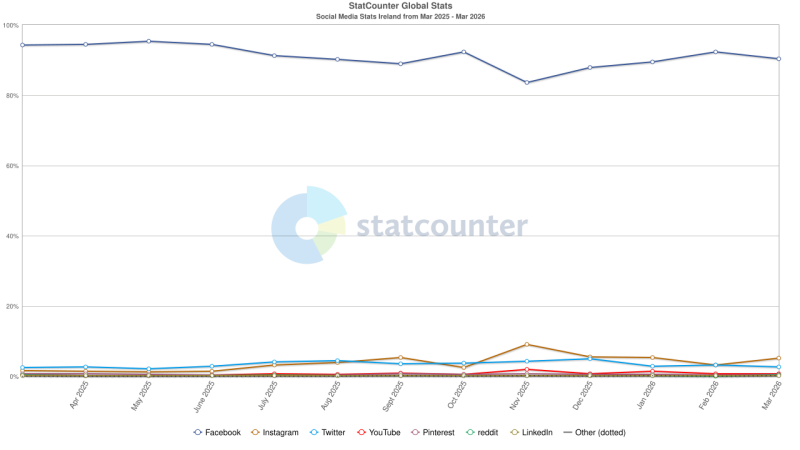
These numbers don’t only show how far reaching these platforms are, but how inevitable they have become in modern life. It is not only the number of users that is a worry but the time spent on these platforms too. Adam Atler writes that, ‘Most people spend between one and four hours on their phones each day – and many far longer.’[4] And one of the reasons many of us are spending such long hours of the day comes from how these platforms have been engineered to managed our time and attention effectively. This has been achieved through the aggressive engagement technique of infinite scroll or often referred to colloquially as ‘doomscrolling.’[5] Jennifer O’Connell’s article in the Irish Times highlights this problem, she writes that,
‘Infinite scroll is, of course, just one of the things that make smartphones so addictive. Autoplay, a variation on the theme, is how YouTube, TikTok and Snapchat keep you hooked, automatically playing the next video in your feed. Algorithms are designed to feed you more and more of the same content.’[6]
To add to the severity of doomscrolling, let us picture this scenario together. A person comes from a long day of work. They are exhausted, both mentally and physically. Their body needs a rest. They are also hungry. So they decide to prepare some food. Once it’s done they set it on a table, ready to be eaten. Logic would tell us that the next move would be to either eat the food or go to sleep. But what ends up happening is that the food remains untouched because of the device in their hand, putting things on hold, delaying the eating or sleeping, until the perfect video, reel, or story has been found to match the consumption. Dinner time is compromised. Sleep time even worse. Instead of listening to the body’s pleas for shutting down, the rectangular device shoves itself into the person’s face in the darkness of a room and overstimulating them into the night. And so has begun the long march into a form of mental paralysis, our eyes glued to phones instead of what appears beyond them, our thumbs motioning LCD screens from left to right, upwards and down, having more realness than that which can be touched or felt, and our minds hooked on the dopamine that is produced . There’s a book called Stolen Focus. It was published in 2022 and written by Johann Hari. In it he argues that the elements of our modern life including smart phones and social media, are ‘destroying our ability to concentrate.’[7] But it is not only our ability to concentrate or attend to life’s simple tasks (like eating or sleeping without our phones), but our capacity to think has been impeded too. This quote from an article points out how such large language models like Open AI are turning us into a post literate society:
‘There is also increasing evidence that working with AI a lot leads to a “cognitive debt”. [in other words] it makes us dumber. Studies suggest that while using LLMs can speed up work, the user’s understanding of that work is degraded and their ability to analyse and breakdown the process after the fact is compromised. Meanwhile their confidence in doing the work independently is undermined by the relative fluency of the machine.’[8]
The worrisome repercussions of these technologies don’t only affect us at the individual level, but they affect the quality of our communities too. Max Fisher in his book, The Chaos Machine, explores how social media algorithms were intentionally designed to exploit human psychology by maximizing its engagement, which has turned out to be something that has led to global polarization, misinformation, and even violence.[9] Social media would like to make us believe that it exposes the hidden, but all this exposure does is aggravate certain social and political ideas that then births an environment of animosity – an us versus them mentality. This is what Max Fisher’s book warns us about. These platforms aren’t simply designed for the individual to pass time scrolling whilst bored. They function at the highest levels of political indoctrination and social stigmatisation. So these platforms have not only taken away our relationality with others, but they have driven us towards negative emotions, forcing us to look at the world differently, to invent more enemies, to stir up anxiety, and aggravate social tensions across racial lines, gender & identity, and migration, etc. Now in light of all this information, what can a simple activity like engaging with art meaningfully do to lessen or even mitigate the negative effects of these platforms?
How Art Can Address These Issues:
Chinua Achebe has been noted for saying that ‘Art is man’s constant effort to create for himself a different order of reality from that which is given to him.’ The importance of engaging with art, (in all its varied forms i.e. literature, films, music, paintings, etc.) in this day and age of the internet, cannot be limited to the use of its entertainment value or ability for escapism. Engaging with art can do much more for us. For example reading a book or appreciating a certain discipline in the visual arts can be a simple task that can help us rewire our brain. It can help us redirect our focus. And it can help us be more intentional with our thoughts and understanding of the world around us. When a piece of literature manages to find its way into our hearts it has the capacity to substitute (replace) the large space these platforms occupy in our lives. Ultimately an intentional approach to artistic engagement bears the power to be transformative. It can do this in three important ways:
(1) Through Nature: English Poet William Wordsworth wrote a lot about our relation to nature. His writing comes to mind given how virtual and digitized our lives have become. His themes on nature are a clear example of how one can overcome the addictive cycles of these platforms. In Wordsworth’s time, industrialization was the great disruptive technology. So it isn’t that much of a leap from today’s disruptive technologies. The same principles he elucidated in his writings about nature, such as it being a teacher, a healer, and a direction to turn to when the world was literally becoming metal, are the principles we can apply today. Reading about nature, as Wordsworth would have implied, made you want to see nature and be present in it, physically not virtually. Poets and writers of nature remind us to have a healthy dose of technophobia.[10]
(2) Through People: The role of art in society has always been, at a fundamental level, to connect us more deeply to our fellow humans. Even though art can be enjoyed in isolation, the discussion one has about it is something that can only be done in the company of others. Russian novelist Tolstoy defined it like this: ‘Art begins when a man, with the purpose of communicating to other people a feeling he once experienced, calls it up again within himself and expresses it by certain external signs.’ These deeply human emotions, the things that move us and make us feel, these are the experiences that form the engagement with art meaningfully. And it is these things that cannot be provided for by social media apps and networks – they are the space to experience life through oneself and other people.
(3) Through God: And finally, art points us upward, to God. It is no mistake that some of the most famous artistic images in history are religious. Our devotion to a higher power is deeply rooted in the things we create. The things we hold sacred. The writings of Dostoevsky (another Russian novelist), or the paintings of the renaissance period, or even to include a much wider variety to this – the hymns of Enoch Sontoga, a fellow African, are but the few examples of how art, music, literature have sustained people faiths in God. True alignment to the divine leaves no room for the traps that come with social media.
And thus fulfills the way our engagement with art can become meaningful for our lives, not only to overcome social platforms and their addictive tendencies, but to remind ourselves that these things we hold in our hands are not the sum of all that life has to offer. It is important to note that these technologies are here to stay. They will only get more addictive and more pervasive. The world has already shifted in this order, and swimming against the tide might come off as ridiculous, or even impossible. But even as this happens, humans will always remain human – they will want a connection that goes beyond the things that appear on a screen. Our ability to log out of this online world, to see the world that is in front of us, to see others, not as defined by the divisive rhetoric of online interactions, but to see people as people (which are such things that meaningful art helps us see), these are the things that will help us navigate this coming world of total digitization.
References
1 Adam Atler, Irresistible: The Rise of Addictive Technology and the Business of Keeping us Hooked, New York, 2017, Penguin Press, (p13).
2 Source: https://www.irishtimes.com/business/2025/12/05/social-media-use-grows-overall-but-young-people-retreat-cso-shows/ [accessed Wednesday, April 22, 2026].
3 Source: https://gs.statcounter.com/social-media-stats/all/ireland#:~:text=This%20graph%20shows%20the%20stats%20of%20social,Instagram%20has%205.2%25%20and%20Twitter%20has%202.59%25 [accessed Wednesday, April 22, 2026].
4 Adam Atler, Irresistible: The Rise of Addictive Technology and the Business of Keeping us Hooked, New York, 2017, Penguin Press, (p17).
5 As offered by the Merriam-Webster online dictionary, Doomscrolling is defined as the act of obsessively consuming large amounts of negative news or social media content, even though it causes sadness, anxiety, or burnout. It involves continuous, involuntary scrolling through distressing topics like crises, wars, or online arguments, often at night. See: https://www.merriam-webster.com/dictionary/doomscroll
6 Source: https://www.irishtimes.com/opinion/2026/03/29/jennifer-oconnell-addictive-by-design-this-is-the-verdict-every-parent-has-been-waiting-for/ [accessed Wednesday, April 22, 2026].
7 Johann Hari, Stolen Focus: Why You Can’t Pay Attention, London, 2022, Bloomsbury Publishing.
8 Source: https://www.irishtimes.com/life-style/people/2026/04/18/patrick-freyne-heres-why-ai-is-making-us-dumber-and-more-lonely/ [accessed Wednesday, April 22, 2026].
9 Max Fisher, The Chaos Machine: The Inside Story of how Social Media Rewired Our Minds and Our World, New York, 2023, Back Bay Books.
10 describes the fear, dislike, or avoidance of advanced technology, particularly computers.
Add comment
Comments